
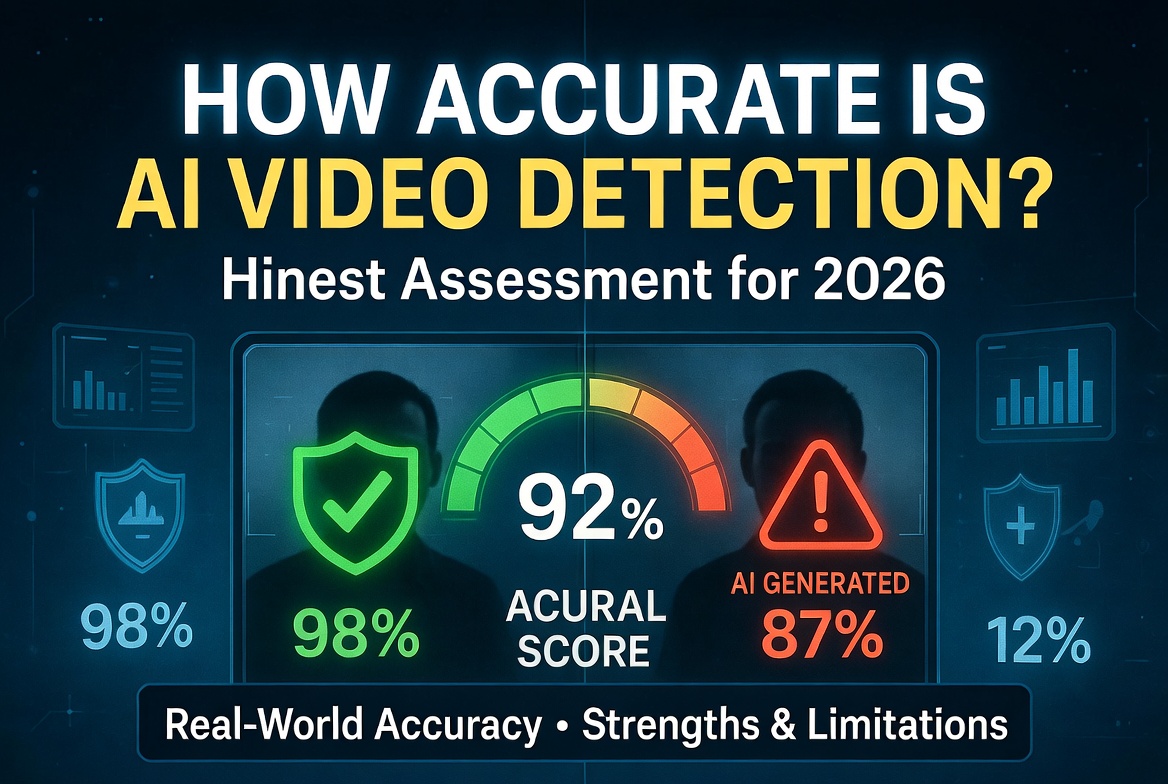
Before you rely on any AI video detection tool — including ours — you deserve an honest answer about accuracy. This article gives you real numbers, explains what causes false positives and false negatives, and tells you how to interpret detection results responsibly.

Current Accuracy Benchmarks
- Well-documented older models (Sora 1, Runway Gen-2, Stable Video Diffusion): 90–95% accuracy on standard-length, uncompressed clips
- Sora 2 (mixed diffusion-transformer architecture): 80–88% accuracy, reflecting fewer visible artifacts
- Short clips under 5 seconds: 70–80%, limited by insufficient frame data for statistical analysis
- Heavily compressed video (downloaded from TikTok, Instagram): 72–82%, compression noise partially masks AI signatures
- Brand-new unreleased models: Below 70% until the detector is updated with training data from the new model
False Positives: When Real Video Gets Flagged
False positives — where authentic video is incorrectly flagged as AI-generated — can occur with: heavily post-processed or filtered real video, video shot with unusual optical setups (anamorphic lenses, extreme shallow depth of field), and animated or CGI content that was never intended to look photorealistic but is not AI-generated in the deepfake sense.
False Negatives: When AI Video Gets Through
False negatives — where AI-generated video passes as authentic — are more dangerous. They occur most often with: very short clips, re-recorded AI video (played on a screen and filmed with a real camera), adversarially processed video deliberately designed to hide AI artifacts, and videos from newly released generators the detector has not yet been trained on.
How to Use Accuracy Information Responsibly
A positive result from our free Sora AI Detector is a strong signal warranting further investigation — not an automatic verdict. A negative result reduces but does not eliminate suspicion. For high-stakes decisions — publishing news, legal proceedings, HR decisions — always combine automated detection with the manual techniques in our complete detection guide. Read also: can AI video be detected? and our comparison of AI video detection tools.
How to Calibrate Your Trust in Detection Results
Knowing the accuracy numbers is one thing. Knowing how to act on a specific result is another. Here is a practical framework:
For a score above 80% (High AI probability)
Treat the video as likely synthetic. Do not share without further verification. Do not rely on it for financial, legal, or editorial decisions. Apply the manual visual checks from our 10 signs of AI-generated video to confirm. Check metadata and run a reverse video search on key frames.
For a score of 40–80% (Moderate probability)
The video has AI generation signals but also some authentic characteristics. This range is where most manual verification effort should be focused. Consider the context: is this video claiming to show a real event? Is it from an anonymous account? Are there other independent recordings of the same event? For professional contexts, escalate to a qualified forensics expert.
For a score below 40% (Low probability)
The video does not show obvious AI generation signals. For casual use, this is reassuring. For high-stakes decisions, still apply corroboration checks. Remember: a false negative rate of 5–10% means approximately 1 in 10 to 1 in 20 AI-generated videos from well-known models will receive a low score. Do not treat any automated result as infallible.

The Arms Race: Why Accuracy Is a Moving Target
AI video generation and AI video detection are in continuous co-evolution. When a new generation model is released, detection tools are initially less effective on its output because they have not yet been trained on enough examples. As examples accumulate and detection models are retrained, accuracy improves. The practical implication: always check whether the detection tool you are using has been updated to cover the specific model you are concerned about.
Our detector is continuously updated as new models are released and as new training data becomes available. Follow our AI News section for announcements of coverage updates. For the post-Sora landscape — as Runway Gen-3, Google Veo 3, and other models take prominence — read our Runway AI video detection guide and watch for upcoming guides on Veo 3.
For the complete methodology combining automated detection with manual techniques, see our comprehensive detection guide. For the best current tools across the market, see our 2026 AI video detectors comparison.