
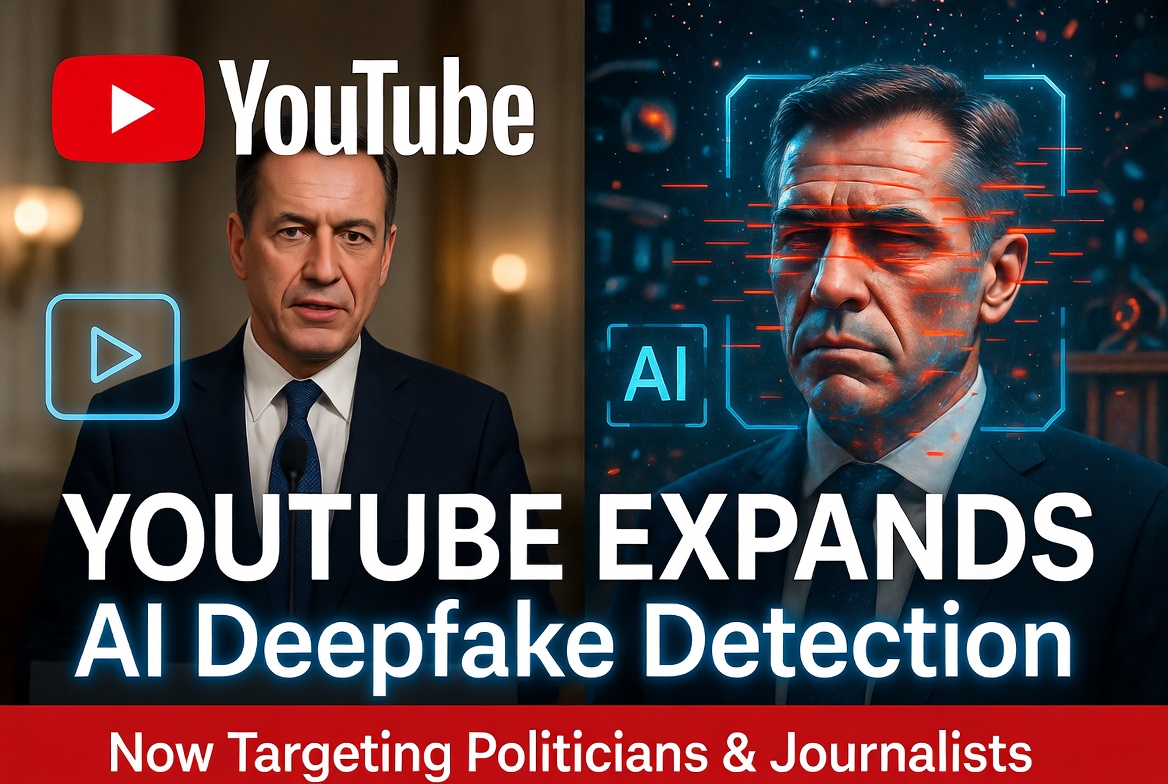
YouTube announced in March 2026 that it is expanding its AI deepfake detection technology — previously available only to YouTube Partner Programme creators — to a new pilot group that includes government officials, political candidates, and journalists. The move comes as AI-generated video featuring fabricated versions of public figures reaches unprecedented scale across social media platforms.
How YouTube’s Deepfake Detection Works
Operating similarly to YouTube’s existing Content ID copyright system, the likeness detection feature scans uploaded videos for AI-simulated faces that match registered individuals. When a match is detected, the verified individual is notified and given the option to request removal if the content violates YouTube policy. The technology launched in limited form to approximately 4 million creators in the YouTube Partner Programme before being expanded in 2026.
Why Politicians and Journalists Were Added
Politicians, government officials, and journalists are disproportionately targeted by deepfake content. AI-generated video of political candidates making fabricated statements has already appeared in the 2026 US midterm campaign cycle. Journalists have had synthetic video fabrications circulated to undermine their credibility. YouTube VP of Creator Products Amjad Hanif explained that content in “sensitive topic” categories receives more prominent AI labels placed at the front of the video rather than buried in the description.
What the Labels Actually Look Like
YouTube’s AI content labelling is not yet consistent. For general AI-generated content, the label appears in the video description. For content in sensitive topic categories — which includes political content and news — the label appears at the beginning of the video. YouTube acknowledged the inconsistency and indicated it plans to extend the detection system to cover recognisable spoken voices and iconic characters beyond faces. The company did not disclose specific politicians or officials included in the initial pilot.
Platform Detection Is Not Enough
YouTube’s expansion is a significant step, but platform-level moderation has well-documented limitations: content spreads faster than moderation responds, labels are easily missed, and bad actors use platforms that have no detection systems at all. A 2026 study published in Communications Psychology found that people remain influenced by deepfake video even when they are told it is fake before watching — meaning even labelled content causes harm. Individual verification remains essential.
What You Can Do
Do not wait for platform labels to protect you. If you encounter video of a public figure making surprising or dramatic statements, run it through our free Sora AI Detector for an instant pixel-level analysis. Read our complete AI video detection guide for the full methodology, learn the 10 signs of AI-generated video to catch what automated systems miss, and follow our AI News section for ongoing coverage of platform detection developments.