
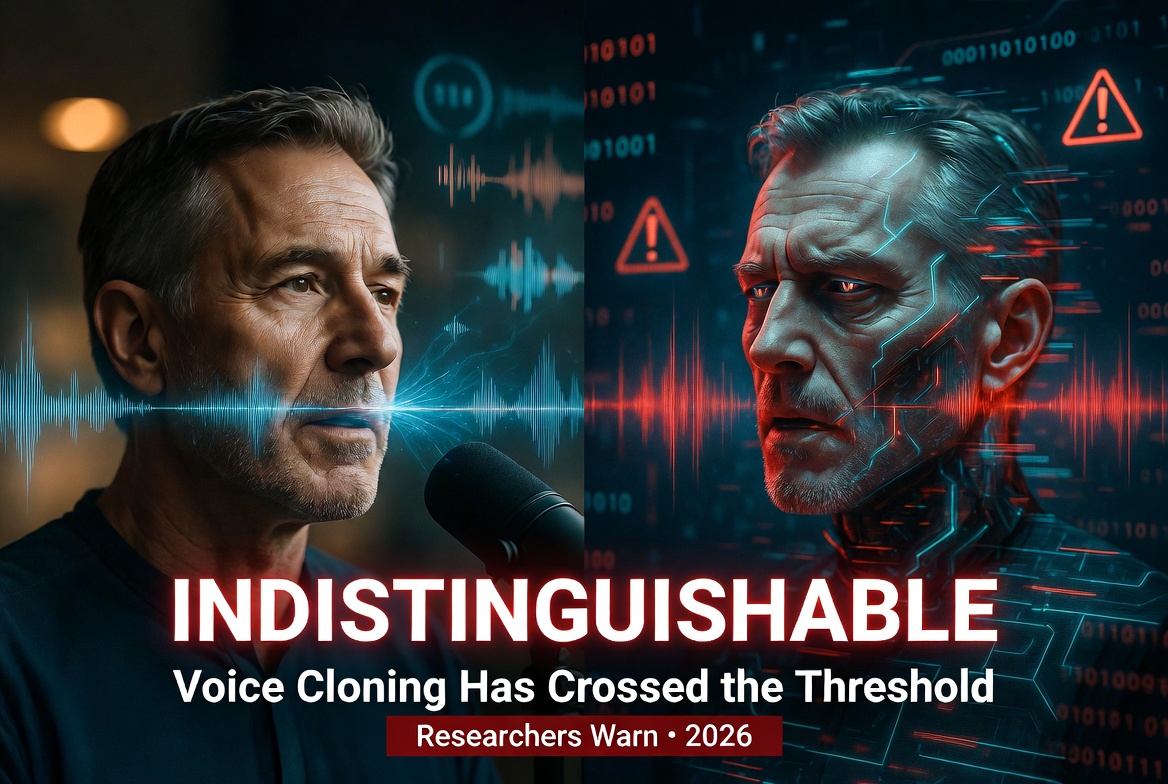
A computer scientist who researches synthetic media at the University at Buffalo published a stark assessment in late 2025: artificial intelligence voice cloning has crossed what they describe as the “indistinguishable threshold.” A few seconds of audio — captured from a social media post, a podcast, a video call — is now enough to generate a convincing voice clone complete with natural intonation, rhythm, emphasis, emotion, pauses, and breathing. The perceptual tells that once gave away synthetic voices have largely disappeared.
The Scale of the Problem: 8 Million Deepfakes Online in 2025
Cybersecurity firm DeepStrike estimated that online deepfake content grew from approximately 500,000 instances in 2023 to around 8 million in 2025 — annual growth nearing 900%. This surge reflects not just improved generation quality but dramatically reduced technical barriers. Tools from OpenAI, Google, and a wave of startups mean anyone can describe an idea, generate a script with a large language model, and produce polished audio-visual synthetic media in minutes. AI agents can now automate the entire pipeline.
Real-Time Deepfakes Are Next
The research community’s concern is no longer limited to pre-rendered synthetic video. The frontier is shifting to real-time synthesis: entire video call participants generated on the fly, responding dynamically to conversation. Some major retailers already report receiving over 1,000 AI-generated scam calls per day. University of Florida researchers published a study in early 2026 finding that while AI programs achieve up to 97% accuracy detecting deepfake faces in still images, their performance falls to chance level on deepfake video — while humans correctly identify real versus fake video about two-thirds of the time.

New Detection Research: Environmental Fingerprinting
On April 1, 2026, Binghamton University announced that researcher Yu Chen won a $50,000 grant from the SUNY Technology Accelerator Fund to commercialise a novel detection technology called CerVaLens. Rather than analysing pixel-level statistical artifacts, CerVaLens looks for environmental “fingerprints” — the acoustic, electromagnetic, and temporal signatures of real-world recording environments. No current AI video generator can accurately synthesise the environmental fingerprint of a specific place at a specific time, Chen explained: “They can create a fingerprint that appears genuine or use a fingerprint obtained from earlier media. However, that fingerprint still does not match what they claim to be the time and location.” An initial version of CerVaLens has already been developed for Google Pixel 10 smartphones.
The Shift Away From Human Judgment
Researchers consistently arrive at the same conclusion: as synthetic media quality improves, the meaningful line of defence must shift from individual human perception to infrastructure-level protections. These include cryptographic content provenance standards like C2PA (explained in our C2PA metadata guide), multimodal forensic analysis tools, and platform-level detection systems. Read our full guide on how accurate AI video detection is for an honest assessment of current tool capabilities. Use our free Sora AI Detector for immediate video analysis, and follow our AI News section for ongoing coverage of detection research and emerging threats.