
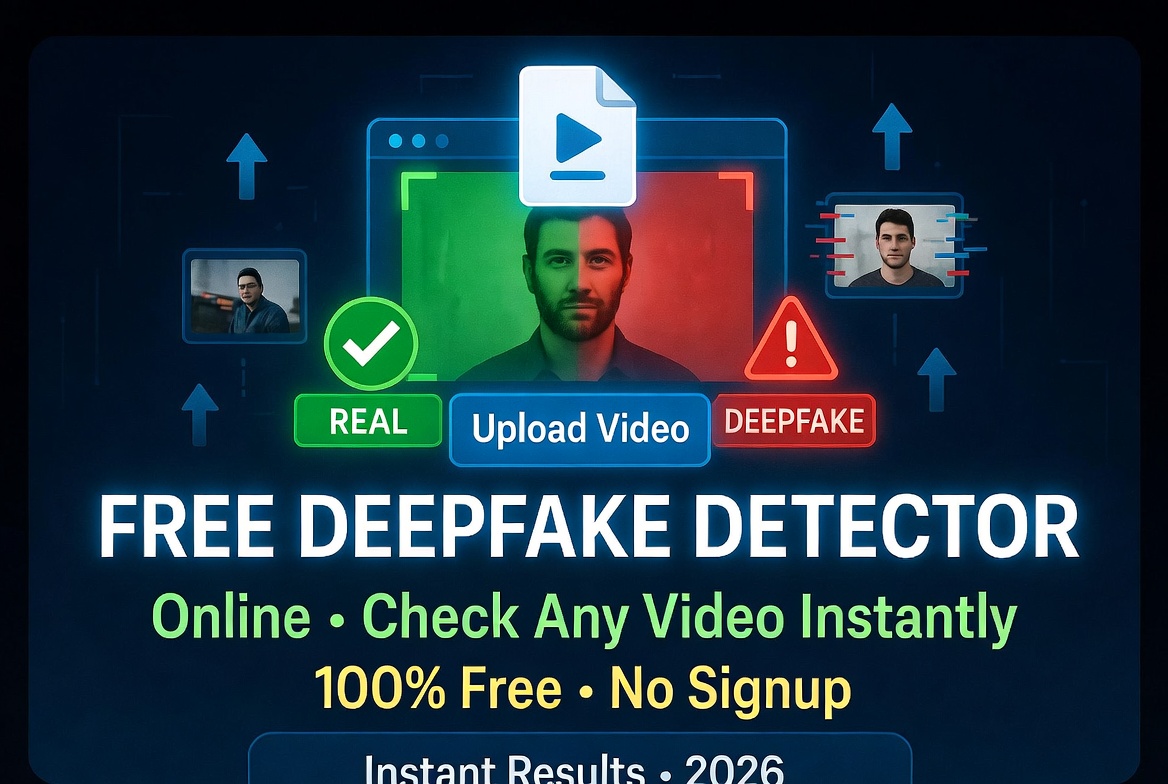
Looking for a free deepfake detector online? Our tool analyses any video for AI generation signatures and deepfake manipulation — no account, no payment, no download required. Upload a file and get your result in seconds.
How to Use the Free Deepfake Detector
- Visit soraaidetector.com
- Upload your video file (MP4, AVI, MOV, and other standard formats supported)
- Wait for analysis — typically completes in seconds
- Review your AI probability score and metric breakdown
What the Detector Checks
The tool analyses three key signals that AI-generated and deepfake video leave behind:
- Colour variance: Natural video has organic colour variation. AI video has statistically different colour distribution patterns.
- Edge complexity: Camera optics create natural edge complexity. AI-generated edges are characteristically smoother.
- Texture uniformity: Real surfaces are organically imperfect. AI-generated textures are measurably more uniform.
Who Uses This Tool?
- Journalists verifying footage before publication — see our journalist guide
- Legal professionals authenticating video evidence — see our legal guide
- Social media users fact-checking viral clips — see our social media guide
- HR teams verifying video interviews
- Anyone who receives a suspicious video and needs a fast second opinion
Limitations to Know
No detector achieves 100% accuracy. Results are most reliable on videos longer than 5 seconds in standard formats. Read our full explanation: can AI video be detected? — covering accuracy rates, limitations, and how to interpret your results. Compare us with other tools in our best AI video detectors review.
The Growing Deepfake Threat: Why Free Detection Matters
Deepfake technology was once the exclusive domain of well-funded research labs. By 2025, generating a convincing deepfake required nothing more than a free account, a smartphone, and a few minutes. This democratisation of synthetic media creation has fundamentally changed the information environment. A free, accessible detection tool is not a luxury — it is a necessary counterbalance to freely available generation.
Face-Swap Deepfakes: What the Detector Finds
The most common type of deepfake takes authentic video footage and replaces one person’s face with another’s. Detection of face-swap deepfakes looks for artifacts specific to this type of manipulation:
- Face-boundary inconsistency: The edge between the swapped face and the original neck/hair/ears often has statistical properties different from genuine facial boundaries.
- Blinking pattern anomalies: Early deepfake models were notorious for unnatural blinking. Modern models have improved but still occasionally produce irregular blink timing or eyelid motion.
- Lighting inconsistency: If the lighting on the swapped face does not match the lighting in the rest of the scene, detection algorithms flag the mismatch.
- Temporal face-warp: In rapid head movements, face-swap models can produce subtle warping at the boundary between the real and synthetic face regions.

Fully Generated AI Video: What the Detector Finds
Fully AI-generated video — like content from Sora, Runway, or Google Veo — is created entirely from scratch with no original real footage. The detection approach differs from face-swap detection because there is no real/fake boundary to find. Instead, the detector looks for the statistical properties of the generation process itself. This is explained in full in our complete AI video detection guide.
What Deepfakes Are Used For: Real Cases
Understanding the real-world use cases for deepfake video helps you know what to watch for. Our AI video fraud cases roundup documents the major cases: the $25M corporate fraud via deepfake video call, political disinformation videos of public figures, celebrity deepfakes for financial scams, and non-consensual synthetic media. The common thread: all could have been caught earlier with a simple detection check.
How to Improve Detection Accuracy on Your Video
- Download and upload the original file rather than a re-shared compressed copy
- Use a clip of at least 5 seconds for statistically reliable results
- For face-swap deepfakes, ensure the subject’s face is clearly visible in the clip
- Avoid using screenshots of video — upload the video file itself
For the full accuracy breakdown including error rates and limitations, read how accurate is AI video detection? Compare our tool with others in our best AI video detectors review. Also see our Sora AI vs deepfake comparison to understand the two main categories of synthetic video threat.